IUGR, goat cheese, and peak nausea
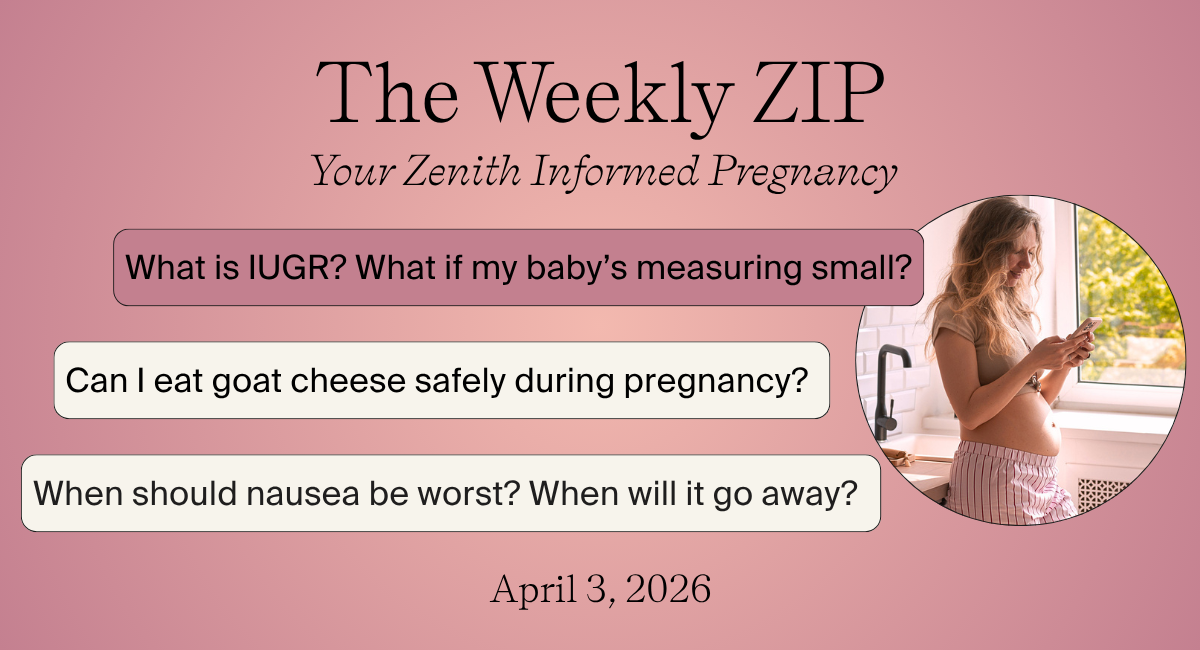
Welcome to the weekly ZIP - your Zenith Informed Pregnancy!
Read on for a quick zip through 3 of the week’s most popular pregnancy questions, and the evidence behind them. Plus - bonus content on the latest & greatest in the world of pregnancy research.
This week's top pregnancy questions:
1️⃣ Is goat cheese safe in pregnancy?
2️⃣ What’s IUGR? What happens if my baby is measuring small?
3️⃣ When is it normal for pregnancy nausea to be worst, and when will it go away?
Is goat cheese safe in pregnancy?
Goat cheese is an ever-trending pregnancy topic – a very popular food (and even craving!), yet a classic gray area with a nuanced answer. Soft cheeses can be treated differently, so here’s what you should know when deciding which cheeses to eat or skip (for now).
📚The tl;dr from the evidence: The key distinction (for goat cheese and all cheeses) isn't the animal the milk comes from, but whether it's made from pasteurized milk. Pasteurization kills listeria monocytogenes, the bacteria that makes many soft cheeses a pregnancy concern. Pregnant people are about 10x more likely to get listeriosis than the general population due to a few different factors, and it can cause serious complications - so it is worth being mindful of, as cliche as it sounds.
Soft, fresh goat cheeses (like the goat cheeses you’d often find in a salad, for example) from pasteurized milk are generally safe, as well as harder/firmer pasteurized goat cheeses. Heat also kills listeria - so goat cheeses that are cooked (for example, as part of a hot dish) are typically safe, especially when heated until steaming hot – listeria is killed at ~165°F.
The broader “rule” across all cheeses: hard cheeses are lower risk, even regardless of pasteurization (low moisture = difficult for listeria to survive). Soft cheeses from pasteurized milk are generally fine. Soft cheeses with rinds, however – like brie, camembert, or aged rind-on goat cheeses – where moisture can allow listeria to survive even after pasteurization, can introduce more risk, as well as anything made from unpasteurized (raw) milk. Imported cheeses are most likely to use unpasteurized milk, so checking the label is always worth it.
👀 Read Penny’s full summary of the evidence for more on goat cheeses
What’s IUGR? What happens if my baby is measuring small?
Hearing that your baby is measuring small can feel alarming, especially when it comes with new acronyms like IUGR or FGR. Here's what that actually means, how confident doctors can be in the assessment, and what care typically looks like.
📚The tl;dr from the evidence: IUGR stands for intrauterine growth restriction (also commonly referred to as FGR, or fetal growth restriction), and refers to a baby not growing at the expected rate in the uterus. IUGR is typically defined as an estimated fetal weight below the 10th percentile for gestational age, and can be diagnosed as early as ~17-20 weeks via ultrasound – although not every small baby has IUGR. True growth restriction, where an underlying cause is limiting growth (like placental insufficiency or maternal health conditions), is more concerning than a baby that is naturally just smaller, or “small for gestational age.”
One important caveat: ultrasound size estimates aren't perfectly precise, and accuracy can actually decrease at lower and higher weight extremes. One single measurement is far less informative than a trend across multiple scans. This is why watching growth over time via a series of ultrasounds is so central to how IUGR is managed. If your baby is measuring small, Doppler blood flow studies – measuring how well blood moves through the umbilical cord and placenta – can give your doctor a much clearer picture of whether a small baby is actually under stress and how to manage care moving forward.
Management depends on severity and how far along you are in pregnancy. Mild cases with normal Doppler findings typically mean increased monitoring. More significant cases, especially with abnormal Doppler findings or signs of distress, may warrant earlier delivery, weighing the risks of prematurity against those of a compromised environment. Key questions you can ask your doctor, if you’re worried about your baby being small: is this based on one measurement or a trend? What do the Doppler findings show? What does the monitoring plan look like for me?
👀 Read Penny’s full summary of the evidence for more on IUGR and measuring small
When is it normal for pregnancy nausea to be worst, and when will it go away?
Morning sickness is one of pregnancy's most notorious symptoms – and of course, one of the most deeply unpleasant. Many moms ask “how much worse can it get??” or “when will it end?” - so here’s some of the (slightly unsatisfying!) evidence on when and why nausea peaks, and when to expect to start feeling some relief.
📚The tl;dr from the evidence: Nausea and vomiting in pregnancy affects most pregnant people and is closely tied to rising hCG – the hormone produced by the developing placenta (the same one that also triggers a positive pregnancy test). While the exact biological mechanism is still not actually known, hCG and nausea timing track very closely together - hCG typically peaks around weeks 8-10, and nausea follows the same arc: symptoms often begin around weeks 6-8, peak around weeks 8-12, and ease for most people by the end of the first trimester.
For most, relief comes naturally as hCG stabilizes and the placenta takes over hormonal production in the second trimester. If nausea isn't improving by the end of the first trimester, or is severe enough to affect your ability to eat and function, talk to your doctor – there are safe and effective options available to help you manage, and it’s important to rule out a more serious condition like hyperemesis gravidarum (severe nausea and vomiting of pregnancy) so that you can get the right care and support that you need.
Because it’s such a common and widely known experience, it can also be normal to worry about not having any nausea. If you're not experiencing morning sickness, that's still within the range of normal – an absence of symptoms doesn't indicate something is wrong. Symptom experience varies widely, and the presence or absence of a single symptom like nausea isn't a reliable indicator of pregnancy health on its own.
👀 Read Penny’s full summary of the evidence for more on when nausea’s worst, and what it means
🤓 Zenith's top read of the week
Bonus: what the Zenith team found interesting this week. Think cool pregnancy research or recently published studies, news in pregnancy health and policy, and more!
COVID-19 mRNA Vaccination in Pregnancy and Risk of Infection in Early Childhood (Helena Eide, MD, MPH, et al., Pediatrics) - This is a cool new study looking at over 146,000 births in Norway to better understand if maternal COVID-19 vaccination during pregnancy can actually help reduce infant infection/hospitalization - as the production of maternal antibodies resulting from vaccination can support increased immunity for their newborns. (Antibodies like immunoglobulin G, which crosses the placenta, and immunoglobulin A, which is present in breastmilk, are what’s responsible for this effect).
The researchers found that maternal vaccination did have a protective effect on their babies - with the most vulnerable infants (0-2 months old) about 50% less likely to be hospitalized for COVID if their mothers were vaccinated during pregnancy. The protection was observed to remain after 2 months, but wane and taper off around the 6 month mark. This is particularly exciting as babies under 6 months can’t receive the vaccine yet, and simultaneously are at amongst the highest risk of any age group for serious infection or hospitalization due to COVID. Great to see more encouraging, high-quality evidence supporting critical protection not just for pregnant moms, but with added benefits for their babies!
Key excerpt:
“In this registry-based national cohort study, we observed no difference in the risk of hospital contacts for infections, except for a reduced risk of COVID-19, among children exposed to COVID-19 vaccination during pregnancy. This protection against COVID-19 waned after 6 months of age."