Tums, cardio, and preventing preeclampsia
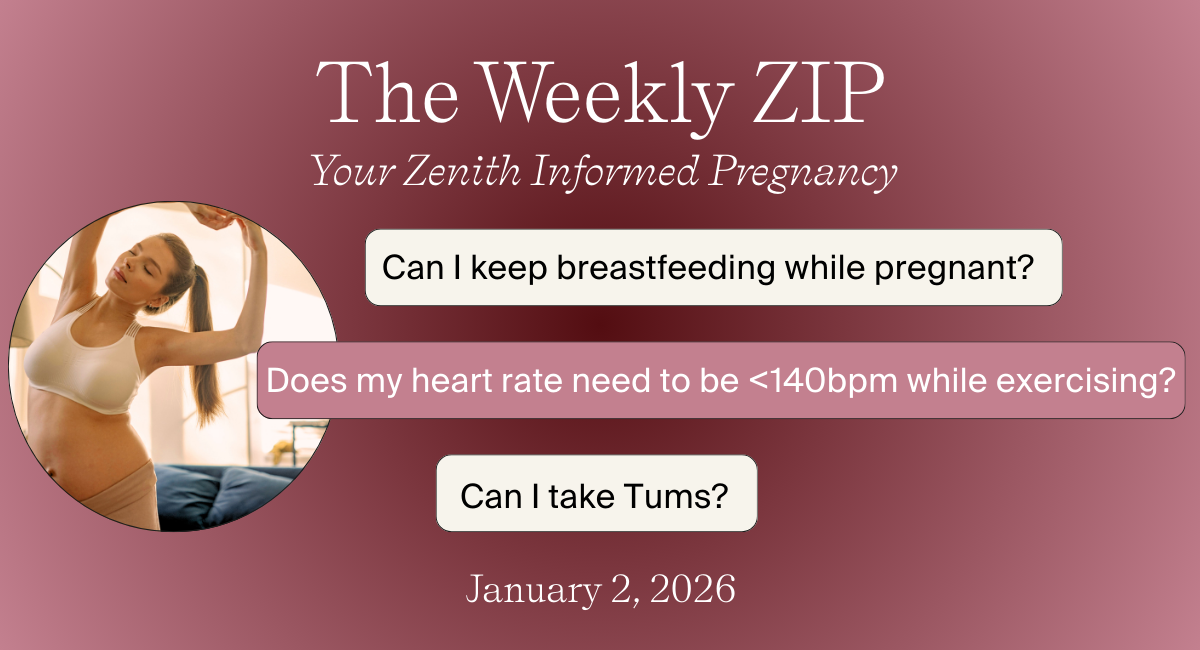
Welcome to the weekly ZIP - your Zenith Informed Pregnancy!
Read on for a quick zip through 3 of the week’s most popular pregnancy questions, and the evidence behind them. Plus - bonus content on the latest & greatest in the world of pregnancy research.
Happy New Year! 2025 had lows and highs around pregnancy research and evidence, but despite the tumult, there were many interesting data points, new research studies, and insights published!
If you missed it, you can check out some of the highlights (including the most asked question of the year, the most surprising data, and 5 of our favorite published research insights) in our Pregnancy Research, Wrapped review on Instagram or TikTok. And now, on to the first questions of 2026!
This week's top pregnancy questions:
1️⃣ Can I keep breastfeeding while pregnant?
2️⃣ Is it true that my heart rate should stay below 140bpm while exercising?
3️⃣ Are Tums okay?
Can I keep breastfeeding while pregnant?
This question is more common than you might think - many moms ask whether or not there are concerns with continuing to breastfeed an older child when they become pregnant with another baby. Here’s what to know about breastfeeding and pumping when becoming pregnant again.
📚The tl;dr from the evidence: In general, continuing breastfeeding/pumping for an older child is not shown in the data to increase adverse outcomes (like increased risk of miscarriage, preterm birth, or other poor pregnancy outcomes). The main concern would be the release of oxytocin that naturally occurs with breastfeeding (oxytocin is a hormone that can cause uterine contractions) and the potential stimulation of contractions, but in most low-risk pregnancies, these contractions wouldn’t be strong enough to cause labor, so not cause for concern.
Most of the research supporting this is based on women with healthy, low-risk pregnancies / no history of pregnancy complications, and more research and data is needed for moms who fall into higher-risk categories (in the meantime, until we have that research - discussing your situation with your OB or MFM is the best approach).
There are some practical considerations, and potential changes to watch out for - while there aren’t any adverse effects for the newborn (e.g. less colostrum, the first milk after birth) or for the older child (e.g. changes in breastmilk during pregnancy), many women do notice effects like increased nipple tenderness, breast soreness, or fatigue. Additionally, as pregnancy progresses, milk supply often decreases naturally, and the taste of the milk may change, which can possibly lead to the older child naturally weaning away from breastmilk.
👀 Read Penny’s full summary of the evidence for more on breastfeeding while pregnant
Is it true that my heart rate should stay below 140bpm while exercising?
With the new year comes an onslaught of new year’s resolutions, many of which include fitness-related goals. There are reasonable modifications that are often suggested to exercise routines and fitness goals while pregnant, but what about the “140 bpm rule” - does science actually support this commonly touted advice?
📚The tl;dr from the evidence: In short, the guidance of keeping your heart rate below 140bpm while exercising is outdated, as it’s not supported by evidence. While it might be commonly referenced even today as a ‘rule of thumb’, it was actually retired from formal guidance years ago! When initially introduced in the 1980s, there was little research on exercise safety in pregnancy, and the guidance was based not in observed data or physiological calculations, but as a generally conservative approach meant to reduce theoretical risks (like reduced blood flow or overheating) from increased maternal heart rate.
The evidence we do have doesn’t show any particular heart rate threshold to stay within (unless your provider gives you a specific reason to do so), and focuses instead on perceived effort level and listening to your body.
Exercise guidance, including with cardio, is somewhat specific to your pre-pregnancy exercise norms – but overall, the most important thing to be mindful of is avoiding adverse effects like overheating, dehydration, exhaustion, or unusual symptoms like chest pain, dizziness/faintness, or vaginal bleeding. If you experience any of these during exercise, it’s a good idea to stop and consult with your doctor.
👀 Read Penny’s full summary of the evidence for more on cardio and exercise guidance
Are Tums okay?
Heartburn can be both a frequent and infuriating symptom during pregnancy, and Tums are often on hand in the medicine cabinet. Here’s what the data shows for one of the most common pregnancy questions, no matter the season.
📚The tl;dr from the evidence: When used as directed, Tums (or calcium carbonate) are considered one of the safest antacids during pregnancy. If you’re experiencing heartburn or indigestion, Tums is a safe and researched remedy that you can try. While sometimes tempting, it’s important not to exceed the daily recommended amount (~4-5 tablets in 24 hours, but always check the label on your specific product to be sure) as excess calcium carbonate may lead to complications.
Some guidelines even recommend calcium-based antacids like Tums as the first treatment to try given the strong safety profile in addition to the benefit of providing added calcium - an important mineral during pregnancy!
👀 Read Penny’s full summary of the evidence for more on Tums and heartburn relief
🤓 Zenith's top read of the week
Bonus: what the Zenith team found interesting this week. Think cool pregnancy research or recently published studies, news in pregnancy health and policy, and more!
Scheduled birth at term for the prsevention of pre-eclampsia (PREVENT-PE): an open-label randomised controlled trial (Dr. James Goadsby, et al., The Lancet) - The PREVENT-PE trial is a really interesting new study coming out of the UK, focusing on interventions that may prevent the onset of preeclampsia (one of the most serious pregnancy complications) for women who are at high risk. The findings, published a few weeks ago, are promising!
They tested – in a randomized controlled trial, the gold standard for evidence – whether a planned birth (via either a scheduled induction or C-section) could lower the incidence of preeclampsia, and their data demonstrated a 30% reduction in preeclampsia between the intervention (planned birth) and control (standard care) groups. This is a super exciting finding, and one that is straightforward to expand to clinical practice! While there’s no current ‘silver bullet’ to truly prevent preeclampsia, and the risk in this study was shown to be reduced, but not eliminated – it’s exciting to see novel research digging into what can more proactively be done to manage against preeclampsia.
Key excerpt:
“To our knowledge, this is the first trial to show that a personalised approach to term pre-eclampsia risk assessment to inform risk-stratified timed birth at term can reduce the incidence of disease in women, without increasing harms, including emergency caesarean birth or prolonged neonatal unit admission."